Split Ship Management
SIMULATORS
Bridge Simulator
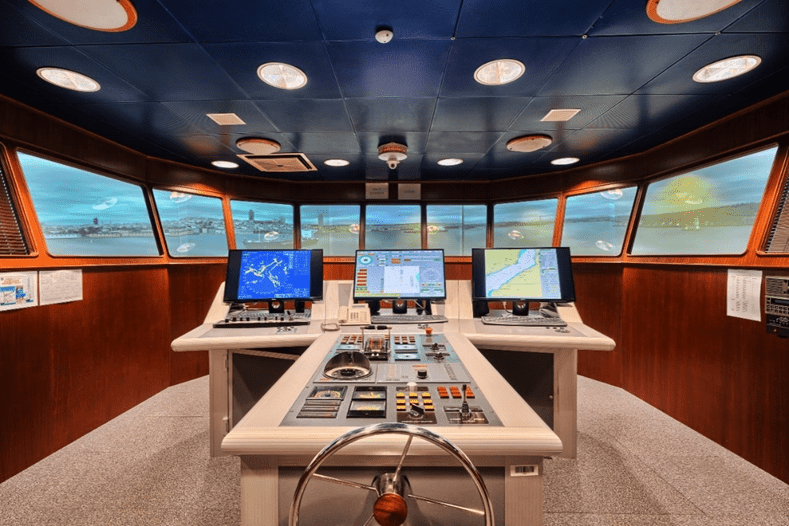
Last year, we upgraded the Transas Full Mission Simulator Bridge to the latest version – 4000 – so we can provide full-scale training for search and rescue actions, as well as for the IAMSAR manual (jointly edited by the International Civil Aviation Organization and the International Maritime Organization). Our bridge simulator now includes modern types of rescue boats, helicopters, and search and rescue facilities at sea; in combination with communication modelling, they enable training in the use of these facilities and in coordination with search and rescue operations in the most unfavourable weather conditions. Synchronised recording and playback of events, equipment use, and air exchange are the most effective ways to deliver life-saving training at sea.
Approved by the Croatian Register of Shipping, the Ministry of the Sea, Transport and Infrastructure of the Republic of Croatia, the Maritime and Coastguard Agency, DNV (Det Norske Veritas Product certificate), and Transas.


Simulator Features
- NT Pro 4000 Simulator with Navi Sailor ED, Full Mission type
- Operational system: Windows 7 SP3
- Certified by DNV to “Class A – Capable of Simulating all Environments”
- Database for 22 different vessel types, including three tankers up to 346,000 dwt
- Database for 65 different “gaming areas” including Milford Haven, Rotterdam and Singapore
- Worldwide portfolio of electronic charts
- Possibility to create your own vessel using main particulars and hydrostatic data
- Possibility to create any particular port or gaming area
- Linked to Transas 4000 Engine Room Simulator, TGS – GMDSS Simulator and LCHS Simulator
- Possibility of joint operations, Bridge / Engine room
- Possibility to create SAR exercises
- River navigation, operation
- Ice navigation, operation
- Yacht-type boat added, with different versions
- Tug boat added, with different versions
- Hardware: 11 computers, 9 monitors and 5 projectors
- Last updated: February 2023
Ice Simulator
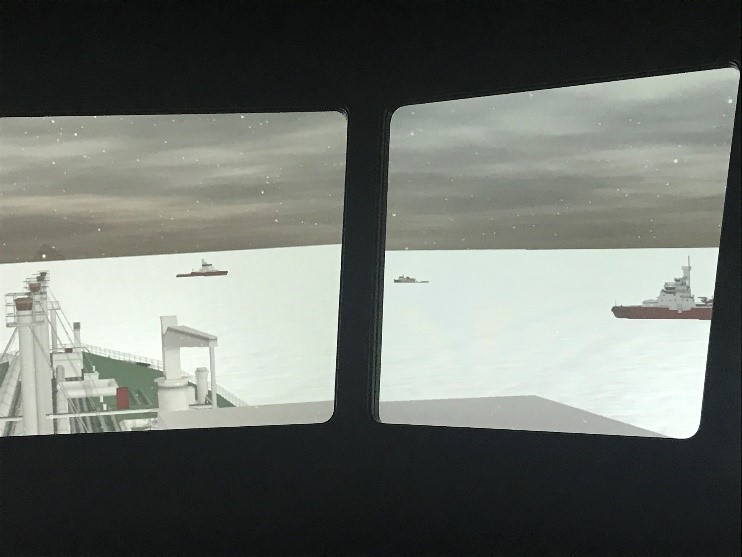
SSM Maritime Training Centre, following high interest, is proud to present one of our newest additions: the world’s latest model of Ice Navigation Simulator, with 50 geographical areas and 30 ship models (LNG, LPG, oil tankers, cruise vessels, fishing boats, VLCC etc. with ice class), with special attention to the busy North Pole cargo route.
Ice Navigation Functionality Module
Areas of application:
- Joint development with the Research Institute of Arctic and Antarctic enables simulation training and competence assessment on ships of 500 gross tonnage or more, navigating in ice conditions:
- when proceeding in broken ice;
- when proceeding along the solid ice edge, bumping against the edge;
- when proceeding in open pack ice, in ice holes and in patches of ice-free water;
- when ice chipping at the channel edges;
- when overcoming ice bridges;
- when colliding with single ice floes.
Navi-Trainer Model Module
Ice field modelling:
- Maximum quantity of these zones is technically not limited and depends on hardware capabilities;
- Ice fields could overlap. The ship model will be affected by both fields when sailing within zones of overlap;
- Concentration of the broken ice in the channel increases linearly from an initial value to the maximum 100%;
- Thickness of the broken ice in the channel is equal to the thickness of the initial ice field;
- The “Crosspiece” parameter specifies the widest ice field that would be broken between two moving ice breakers.
Ship Motion Modelling
- Forces and moments of the hull from movement in broken ice of various solidity and thickness are taken into account;
- mechanical interaction with the edge of solid ice of various thickness, ice breaking;
- effects related to the ship’s interaction with ice: increased resistance to the ship’s motion, limited manoeuvrability, dangerous impacts against ice.
Engine Room Simulator
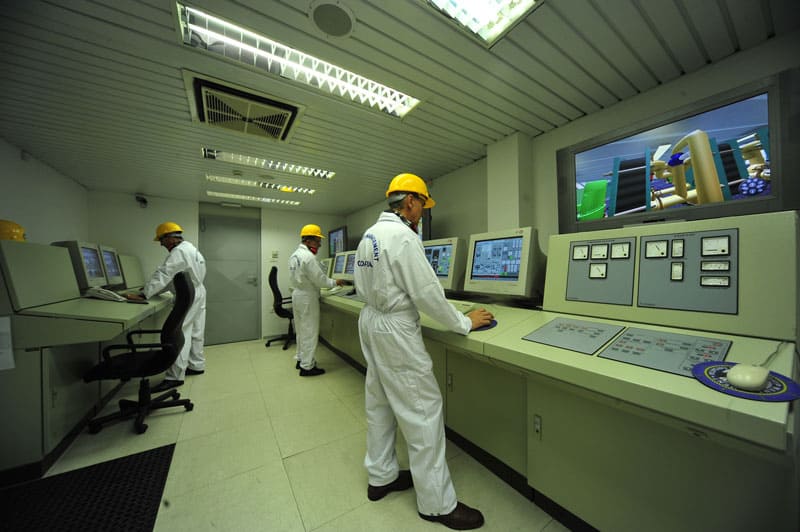
The Full Mission simulator is now upgraded with a steam turbine! We now have a 76,000 DWT LNG Tanker, with a steam turbine as the main engine, driving the fixed pitch propeller through a gearbox. Details are as follows:
- Length o.a., m 276.00 · width mld, m 43.40
- Draft on design WL, m 11.01 · load capacity at SLM, t 76,134
- Freight containers, m3 137,585 · speed, kn 19.5
- Main engine: reversible steam turbine with dual gear reducer, Kawasaki UA-400
- Output MCR, kW 29,450 · R.P.M. H.P. turbine 5,075
- L.P. turbine 3,350 · propeller 90.0
- Output NCR, kW 25,040 / 85.3 R.P.M. — steam conditions at the inlet 57.4 bar, 515°C
- Conditions for full astern strength: 70% of ahead M.C.R. r.p.m. for a period of at least two hours
- Condenser vacuum at top (pump cooling) 722 mmHg Vac. at M.C.R.
- Hot steam 61.5 bar / 515°C / 63,500 kg/h at M.C.R. conditions, propeller FPP
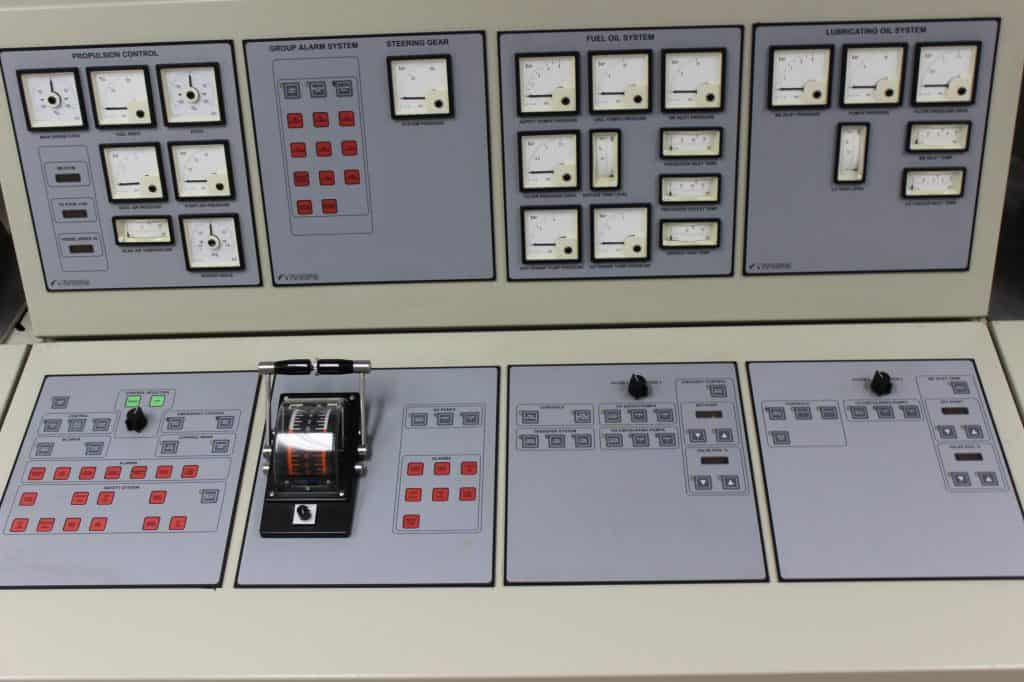
Simulator Features
- Transas 5000, Full Mission type
- Certified by DNV to “Class A”
- Linked to Transas 4000 Bridge Simulator, TGS – GMDSS Simulator
- 4-stroke medium speed diesel engine
- 2-stroke slow speed diesel engine
- Steam Power Plant
- Possibility of joint operations, Bridge / Engine room
- Fixed or controllable pitch propeller
- Ship electric power plant simulator
- Two diesel generators. One shaft generator. Emergency diesel generator.
- Main and emergency switchboard, including synchronising and shore supply sections
- Possibility to create your own engine using main details
- Upgraded in February 2017
- Engine room for familiarisation with engines and equipment
- System of mnemonic diagrams and local control points
- Introduction to the sounds of the engine room
Liquid Cargo Handling Simulator
Dedicated “Cargo Room” with instructor station, four operating stations and eight students capacity. You can practice in the Training Centre with the latest technology — the Transas 4000 LCHS! Our Liquid Cargo Handling Simulator is approved by the Nautical Institute.
- LNG Carrier (membrane and spherical type)
- LPG fully refrigerated carriers
- Chemical Tanker
- Crude Oil Tanker – double hull
- Very Large Crude Carrier (VLCC) – single hull
- Products Tanker – double hull


Cargo handling and auxiliary operations simulators are now one of the most effective and practical ways of training personnel of liquid cargo tankers and gas carriers to perform their functions safely and efficiently. The Liquid Cargo Handling Simulator can be used for studying the tanker’s layout, gear and systems. Training in systems and machinery control, and the correct performance of cargo handling operations in standard operating conditions and emergency situations, is also available. The simulator is aimed at studying tanker systems within the framework of standard IMO courses, as well as per SIGTTO and DNV requirements:
- IMO 2.06 «Oil Tanker Cargo and Ballast Handling Simulator»
- IMO 1.01 «Tanker Familiarization»
- IMO 1.02 «Specialized training for oil tankers»
- IMO 1.04 «Specialized Training for Chemical Tankers»
- IMO 1.06 «Specialized Training for Liquefied Gas Tankers»
SIMULATOR ADVANTAGES
There are many advantages of our LCHS Transas simulator, such as:
Cargo Control System
Transas LCHS has a real cargo calculator, the same one used on more than 4,000 ships worldwide. Tank calculations, hull strength and ship load in the simulator are carried out using the Load Calculator system. This program was included under the terms of STCW-95, B 1/12, and 40 (2,3).
Different Types of Cargo
Various types of cargo can be selected from the database saved in the simulator. These databases have been expanded so that activities can be carried out for virtually any type of cargo.
Mathematical Model
The mathematical model is superior to the models used in simulators manufactured by other manufacturers. It allows processes to be accelerated without compromising physical realism, while also reducing training time.
Graphic User Area
The area is optimised to familiarise trainees with all the principles of the entire operating system and to gain practical skills in handling the equipment. The main tanker operations are shown as 3D versions, showing cross-sections of individual systems. Computer animation is used to display current processes.

GMDSS Simulator
Model Transas TGS 4000 with instructor and student workplaces, imitating SAILOR GMDSS equipment.
- with instructor and student workplaces, imitating SAILOR GMDSS equipment
- Transas 4100, Full Mission type
- Linked to Transas 4000 Bridge Simulator, Transas 5000 Engine Room Simulator and LCHS Simulator
- Equipment: ship’s radio station, communication equipment, VHF with radiotelephony and DSC + watchkeeping receiver (channel 70), Inmarsat C, Inmarsat M
- Upgraded in February 2017
High Voltage Simulator
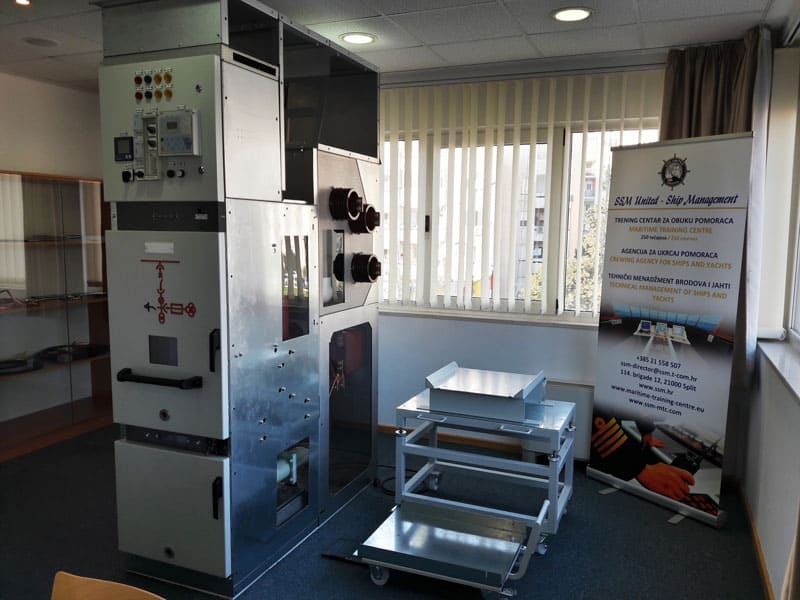
High Voltage training takes place on the modern BVK-M-7,2 simulator, a high-voltage block intended exclusively for marine purposes. Training is divided into two levels – operational and management. It has been developed to deliver education and training covering marine high voltage power systems, meeting specific parts of the regulatory requirements of Tables A-III/1 (operational level) and A-III/2, A-III/3 (management level) of the Annex to the International Convention on Standards of Training, Certification and Watchkeeping for Seafarers (STCW), 1978, as amended. Courses are certified by the Croatian Maritime Administration and MCA UK.
Dynamic Positioning Simulator
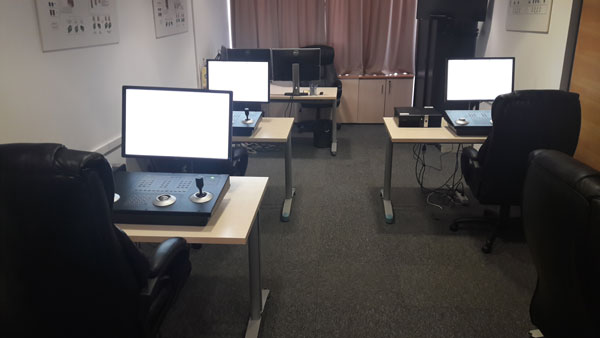
Modern DP training on K-SIM DP basic trainers, Ni class C, 3 units, manufactured by Kongsberg Digital AS. The courses we offer are DP Basic and DP Advanced. Our DP training classroom is equipped for both practical dynamic positioning simulation and theory. Dynamic positioning training is recommended for deck and engineering officers working on any type of vessel equipped with the system, and is required for vessels classed as DP vessels.
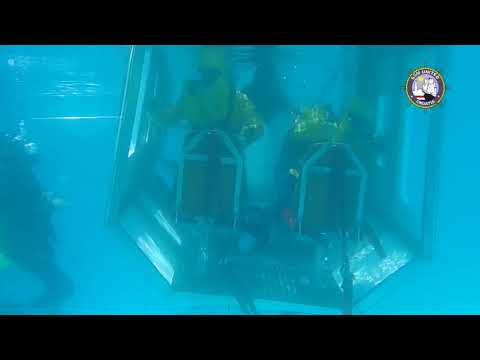
HUET Simulator
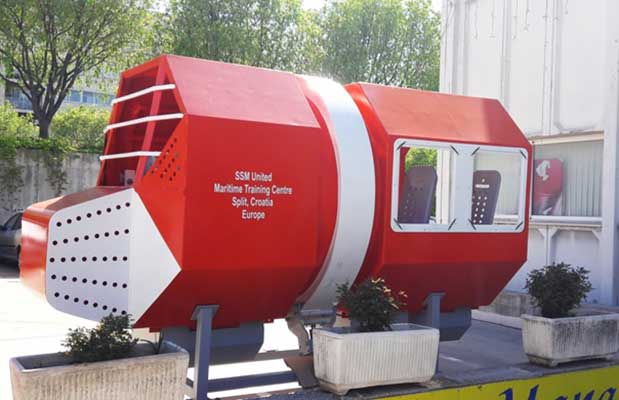
This course is essential in many segments of the maritime industry, especially for staff in the offshore industry, but also for military and mountain rescue service personnel who are regularly transported by helicopter. As the name implies, its purpose is to prepare candidates for emergency exit in the event of a crash landing over water, and to train them for rescue in such situations. The training involves simulated sinking in a pool while rotating the training module upside down, combined with various background situations. At the same time, candidates are familiarised with some of the most important actions connected with a crash: the proper response during the fall, avoiding smoke inhalation, escaping from a helicopter in the quickest and safest way, and surfacing while holding their breath or using an oxygen bottle.
Watch the exercise video!

ECDIS Furuno NavSkills CAT Station
Furuno station for ECDIS-specific training:
- Furuno FEA-2107/FEA-2807
- Furuno FMD 3100/3200/3300
Resnik
At the Resnik training ground, candidates take part in live exercises related to these courses:
D2 – Basic Safety on Board – STCW A-VI/1
Our basic safety course is based on a series of practical demonstration exercises on a boat, a fire range and in a swimming pool:
- dropping and driving a lifeboat
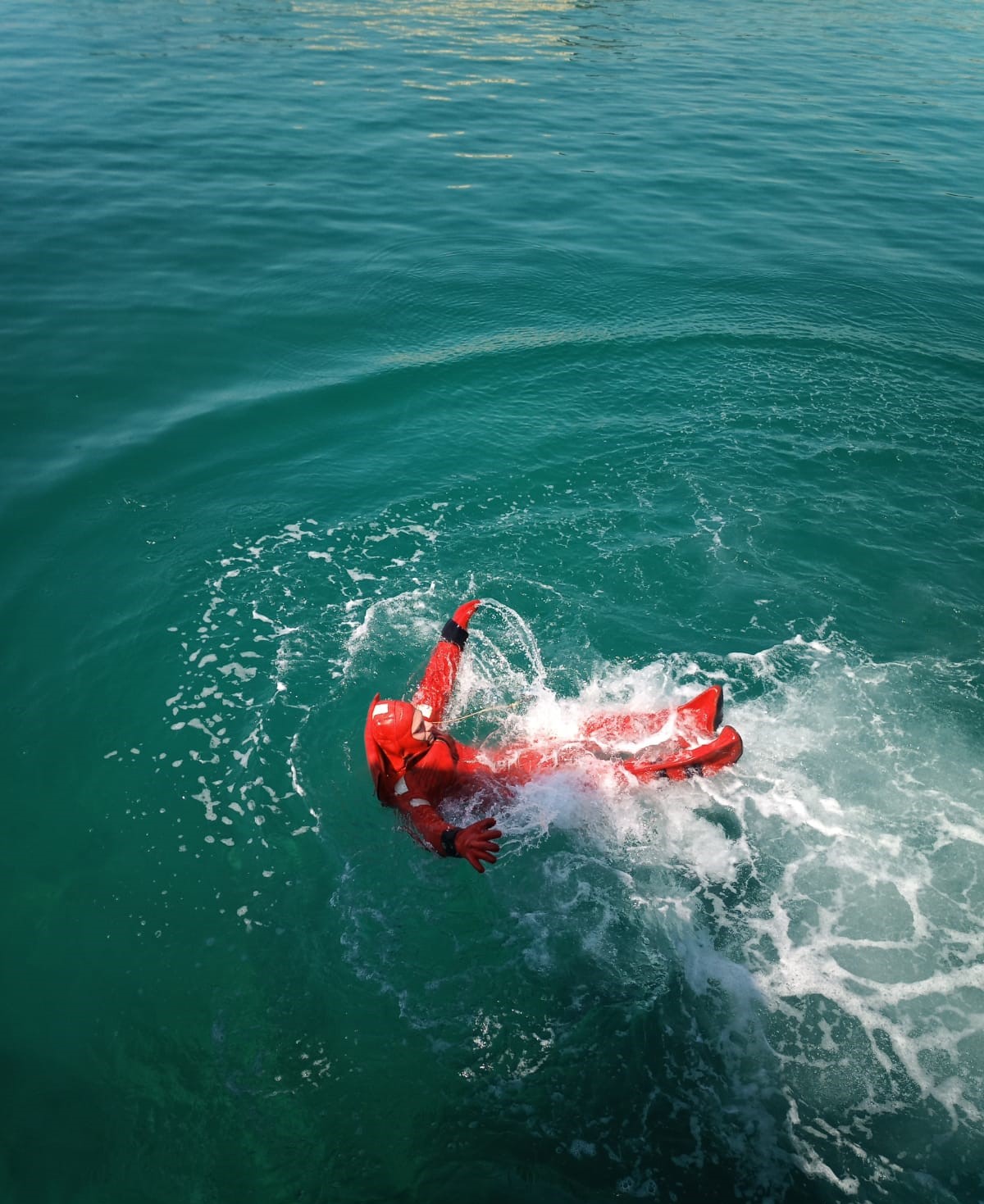
- use of thermal suits and life vests
- opening a life-saving raft
- fire drills on the range
D17 – Proficiency in Survival Craft and Rescue Boats
D18 – Certificate of Proficiency in Fast Rescue Boats
HUET – Helicopter Underwater Escape Training
Rib Boat Operation Training
HLO – Helicopter Landing Officer
Jet Ski Operation Training